Customer
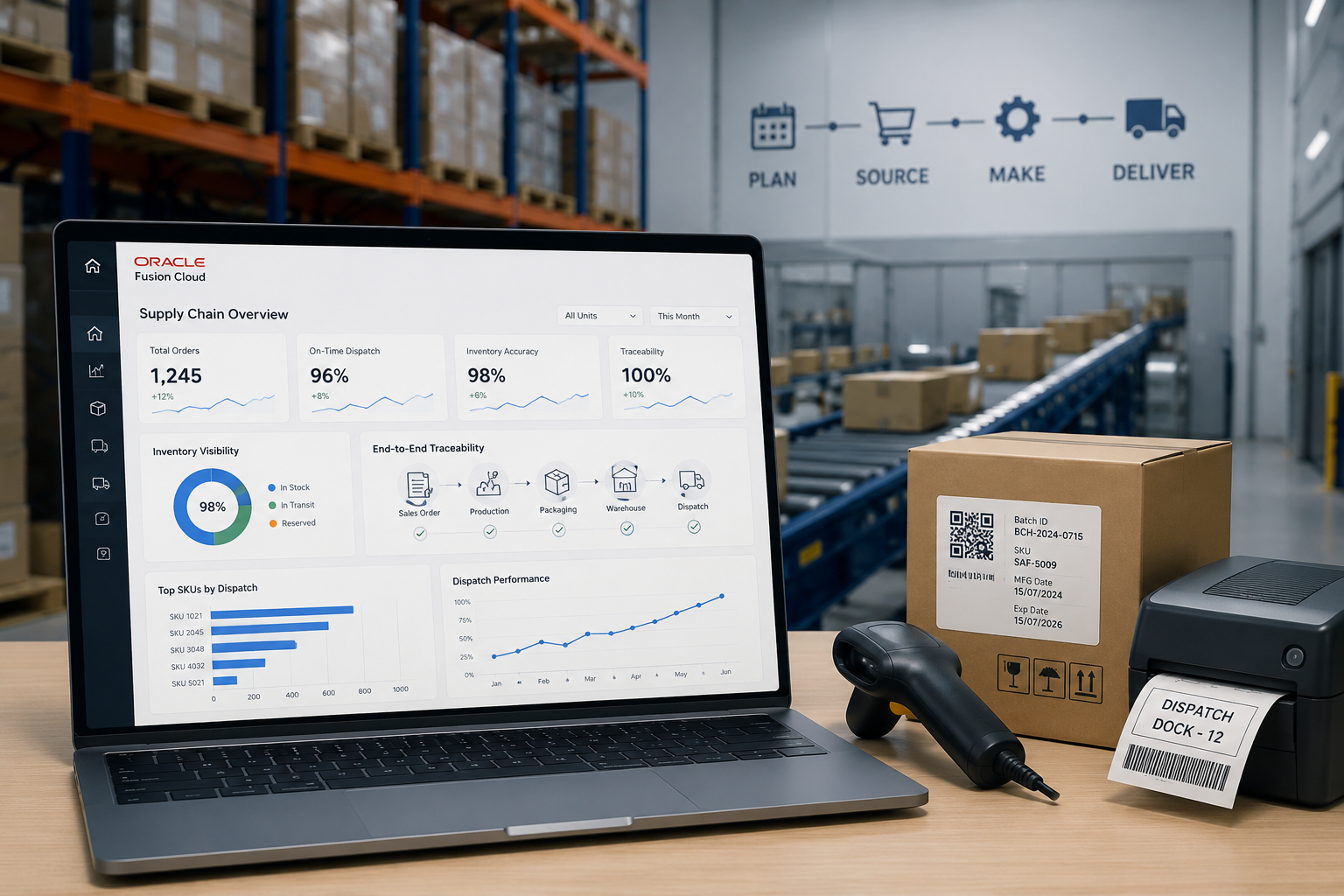
A leading industrial safety equipment manufacturer seeking to modernize and standardize its finished goods supply chain across multiple manufacturing units.
Technology
Oracle Fusion, Supply Chain Digitization, Barcode & QR Code Traceability, Warehouse Management, Business Process Mapping
Business Objective
The client sought to digitize finished goods supply chain operations and establish a standardized, traceable process across manufacturing units.
Key objectives included:
- Digitize finished goods supply chain operations.
- Eliminate manual planning processes.
- Standardize packaging workflows across manufacturing units.
- Improve inventory visibility.
- Enable end-to-end batch traceability.
- Streamline warehouse and dispatch operations.
- Establish a scalable foundation for digital supply chain transformation.
Scope of services
BXI Technology conducted detailed process discovery and supply chain transformation activities across two manufacturing units, including:
- Detailed process discovery across manufacturing units.
- End-to-end workflow mapping from sales order to dispatch.
- Business requirement documentation.
- Current-state gap analysis.
- Future-state supply chain process design.
- Oracle Fusion integration strategy.
- Warehouse, packaging, planning, and dispatch process definition.
- Barcode and QR-based traceability framework.
- Business process mapping and standardization.
Benefits
- Standardized supply chain processes across manufacturing units.
- Reduced manual intervention in planning and operational workflows.
- Improved inventory and packaging visibility.
- End-to-end batch and pallet traceability.
- Enhanced warehouse and dispatch efficiency.
- Improved process governance and operational consistency.
- Established a scalable roadmap for digital supply chain transformation.
Impact
BXI Technology designed a future-ready digital supply chain framework integrated with Oracle Fusion, transforming fragmented manual operations into standardized, traceable, and digitally enabled processes. The solution strengthened operational visibility and process governance while establishing a scalable foundation for intelligent warehouse, packaging, and dispatch management.
Customer
A leading global manufacturer of industrial safety products.
Technology
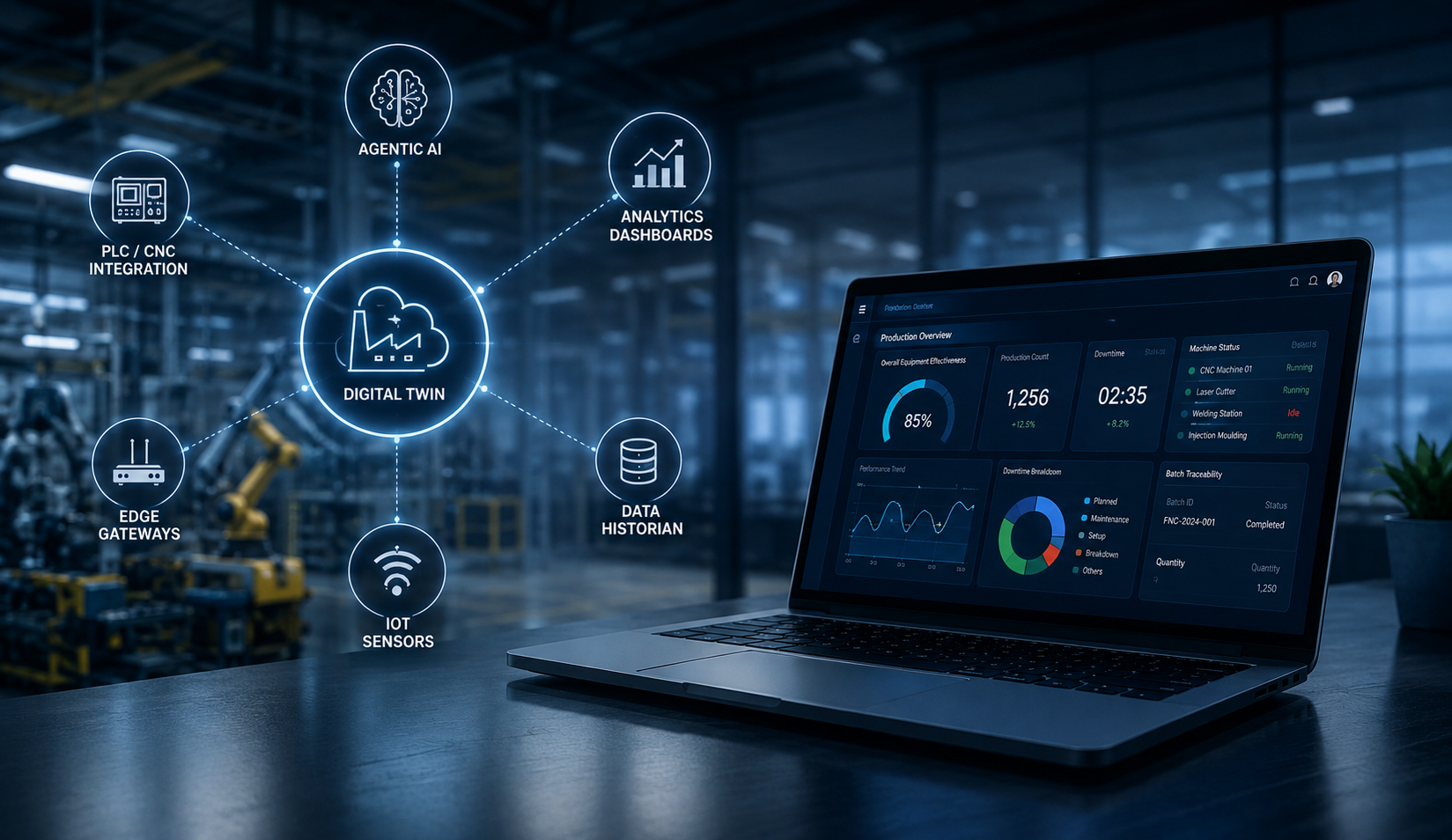
Digital Twin, Agentic AI, Zoho IoT, PLC/CNC Integration, SCADA, Edge Gateways, Industrial Sensors, Data Historian, Analytics Dashboards
Business Objective
The client sought to create a scalable digital manufacturing environment by improving shop-floor visibility, machine utilization monitoring, production tracking, and operational intelligence.
Key objectives included:
- Improve real-time shop-floor visibility.
- Accurately monitor machine utilization and production counts.
- Automate downtime classification.
- Strengthen batch-to-furnace traceability.
- Enhance Overall Equipment Effectiveness (OEE).
- Establish an Industry 5.0-ready digital manufacturing environment.
Scope of services
BXI Technology designed and implemented a Digital Twin and Agentic AI architecture integrated with Zoho IoT across diverse manufacturing equipment and processes.
The engagement included:
- PLC and CNC machine integration.
- Integration with furnaces, laser cutting, grinding, drilling, stamping, welding, and injection moulding equipment.
- Sensor retrofits and edge gateway implementation.
- Industrial protocol integration and real-time data acquisition.
- KPI dashboards and operational analytics.
- Predictive analytics and AI-driven monitoring.
- Batch traceability and batch-to-furnace tracking.
- Standardized IoT architecture across diverse machines.
- Implementation without disrupting existing machine operations.
Benefits
- Real-time visibility into machine status, production counts, downtime, rejects, and cycle times.
- Improved batch-to-furnace traceability.
- Enhanced OEE monitoring.
- Automated operational insights.
- Standardized IoT architecture across diverse manufacturing equipment.
- Scalable foundation for predictive manufacturing.
- Readiness for Industry 5.0 initiatives.
Impact
BXI Technology established a unified Digital Twin and Industrial IoT framework that transformed fragmented shop-floor data into actionable operational intelligence. The solution enabled centralized monitoring, improved production transparency, strengthened quality traceability, and created a scalable foundation for AI-driven manufacturing optimization across multiple production processes.

Introduction
As financial and insurance organizations continue expanding digital operations, infrastructure security becomes critical to protecting sensitive business and customer data. Increasing cyber threats, configuration gaps, and infrastructure vulnerabilities create significant operational and compliance risks.
A multinational insurance enterprise required a structured vulnerability assessment and penetration testing (VAPT) program to identify security weaknesses, strengthen infrastructure resilience, and improve overall cyber risk posture across critical systems.
Customer
A multinational insurance enterprise in Japan operating across multiple business units, seeking to strengthen infrastructure security and reduce exposure to cyber threats and operational vulnerabilities.
Business Objective
- Assess infrastructure security posture across critical environments
- Identify technical vulnerabilities, configuration gaps, and attack surface risks
- Improve security governance and remediation prioritization
- Reduce exposure to infrastructure-based cyber threats
- Validate remediation effectiveness through structured reassessment
Scope of Services
Infrastructure Vulnerability Assessment
Performed comprehensive vulnerability assessments across critical infrastructure environments to identify security weaknesses and exposure points.
Penetration Testing & Attack Surface Analysis
Conducted penetration testing to evaluate exploitability and assess potential attack vectors across systems and applications.
Configuration & Security Review
Reviewed infrastructure configurations to identify security misconfigurations, compliance gaps, and operational risks.
Vulnerability Validation & Prioritization
Validated findings through manual analysis and eliminated false positives to improve assessment accuracy and remediation focus.
Remediation Support & Reassessment
Worked closely with internal teams to provide remediation recommendations and performed rescans to validate corrective actions.
Technology Used
- Vulnerability Assessment & Penetration Testing Tools
- Infrastructure Security Monitoring Platforms
- Configuration Review Frameworks
- Risk Prioritization & Reporting Dashboards
Key Challenges Addressed
- Limited visibility into infrastructure vulnerabilities and attack exposure
- Security risks caused by configuration weaknesses
- False positives impacting remediation efficiency
- Lack of structured prioritization for critical vulnerabilities
- Need for validation of remediation effectiveness across environments
Benefits
Improved Security Visibility
Enabled comprehensive identification of infrastructure vulnerabilities and risk exposure
Reduced Attack Surface
Strengthened infrastructure resilience through remediation and security hardening
Accurate Risk Prioritization
Improved focus on business-critical vulnerabilities requiring immediate action
Enhanced Security Governance
Established structured reporting and validation processes for remediation tracking
Impact
- Identified and assessed critical infrastructure vulnerabilities across environments
- Reduced potential attack surface and infrastructure security risks
- Improved remediation planning and vulnerability prioritization
- Enhanced confidence in infrastructure security posture through validation and rescanning
- Strengthened overall cyber resilience and operational security readiness

Introduction
In the entertainment industry, growth is increasingly driven by the ability to understand and respond to rapidly evolving consumer preferences. While large volumes of customer data exist, many organizations struggle to convert that data into actionable insights that directly impact revenue.
A global entertainment company faced this exact challenge—data was available, but not effectively connected to decision-making, limiting its ability to target high-value customers and drive growth.
Customer
A global entertainment company with diverse content offerings, struggling to translate fragmented customer data into actionable growth strategies.
Business Objective
- Identify and target high-value customer segments
- Improve content relevance and cross-sell opportunities
- Embed data-driven decision-making into business operations
- Accelerate revenue growth through personalized offerings
Scope of Services
Customer Segmentation & Value Identification
Developed a micro-segmentation model to identify high-value customer cohorts and their behavioral patterns.
Data Integration & Insight Layer
Connected point-of-sale and customer interaction data to create a unified view of customer behavior.
Advanced Analytics & Affinity Modeling
Built models to identify relationships between content consumption patterns, enabling smarter bundling and recommendations.
Test-and-Learn Framework
Established experimentation capabilities to continuously refine content offerings and marketing strategies.
Embedded Analytics in Operations
Integrated analytics tools into day-to-day decision-making processes, ensuring sustained adoption and impact.
Technology Used
- Advanced Analytics & Predictive Modeling
- Customer Data Integration Platforms
- Experimentation Frameworks (A/B testing)
- Data Visualization & Insight Tools
- Cloud-based Data Processing
Key Challenges Addressed
- Disconnected customer and transaction data
- Limited visibility into high-value customer segments
- Ineffective content targeting and bundling strategies
- Lack of experimentation culture
- Analytics not embedded into business workflows
Benefits of Entertainment Analytics
Targeted Customer Engagement
Enabled precise targeting of high-value customer segments
Smarter Content Monetization
Improved bundling and recommendation strategies based on affinity insights
Continuous Optimization
Shifted from static strategy to iterative, data-driven decision-making
Operational Adoption of Analytics
Ensured analytics became part of everyday business processes
Impact
- 500% increase in sales of related content in pilot programs
- Improved customer targeting and engagement effectiveness
- Stronger alignment between content strategy and consumer demand
- Accelerated growth through data-driven experimentation

Introduction
Telecom operators often struggle with declining customer satisfaction due to inconsistent service quality, fragmented experiences, and legacy operational models. This case highlights how a telecom provider transformed its business by placing customer experience at the core of its strategy, enabling improved loyalty, retention, and revenue growth. The transformation focused on aligning operations, customer journeys, and performance metrics around a customer-centric approach.
Customer
A telecom operator facing declining customer satisfaction and competitive pressure in a mature market. The organization managed multiple customer touchpoints and services, requiring a more consistent and personalized experience strategy to improve market positioning.
Business Objective
- Improve customer satisfaction and loyalty across services
- Reduce churn and increase long-term customer retention
- Strengthen competitive positioning in a mature telecom market
- Align business strategy with a customer-centric operating model
Scope of Services
- Customer experience strategy definition and planning
- Implementation of Net Promoter System (NPS) framework
- Customer journey redesign across key touchpoints
- Organizational alignment around customer experience metrics
- Performance tracking and continuous improvement initiatives
Technology Used
- Customer experience measurement platforms and NPS systems
- Customer analytics and feedback management tools
- Data platforms for customer insights and reporting
- CRM and interaction tracking systems
Key Challenges Addressed
- Poor customer experience compared to competitors
- Weak network and service perception among customers
- Lack of customer-centric business strategy
- Fragmented service delivery across touchpoints
Benefits
- Improved customer satisfaction and loyalty
- Better alignment between services and customer expectations
- Stronger competitive positioning in the market
- Increased customer advocacy and engagement
Impact
- Companies with strong CX achieve 4–8% higher revenue growth compared to market averages
- Improved Net Promoter Score (NPS) across customer segments
- Reduced churn and increased customer retention
- Higher lifetime value per customer through improved engagement

Introduction
Telecom providers struggle to deliver consistent, personalized customer experiences due to fragmented journeys, siloed teams, and outdated IT systems. This case highlights how a telecom operator transformed its customer experience by combining Agile operating models, modern IT architecture, and data-driven decision-making to deliver seamless, end-to-end customer journeys. The transformation focused on improving collaboration, accelerating execution, and creating a scalable digital customer experience framework.
Customer
A Europe-based telecom operator managing multi-channel customer interactions across mobile and digital services. The organization serves a large customer base and operates across multiple customer touchpoints, requiring consistent engagement and seamless service experiences.
Business Objective
- Improve customer experience across lifecycle journeys
- Reduce churn and increase customer retention
- Enable cross-sell and upsell opportunities across services
- Build a scalable digital operating model for growth
- Modernize IT architecture to support CX transformation
Scope of Services
- End-to-end customer journey mapping and redesign
- Agile operating model setup across business and IT teams
- Cross-functional team enablement across sales, onboarding, and lifecycle management
- IT architecture modernization for CX enablement
- Data-driven prioritization of high-impact customer journeys
Technology Used
- Customer analytics and journey orchestration platforms
- Data science and behavioral analytics tools
- Agile delivery frameworks and collaboration tools
- Modernized IT architecture with cloud-ready modular systems
- API-led integration for customer platforms and systems
Key Challenges Addressed
- Fragmented customer journeys across channels and touchpoints
- Lack of prioritization in customer experience initiatives
- Legacy IT systems limiting scalability and agility
- Siloed teams reducing execution efficiency
- Low customer satisfaction and retention levels
Benefits
- Unified and seamless customer journeys across channels
- Faster execution through Agile operating model adoption
- Improved collaboration across business and IT teams
- Data-driven decision-making for customer experience improvements
- Scalable digital foundation supporting future growth
Impact
- Improved Net Promoter Score (NPS) and customer satisfaction
- Reduced customer churn across services
- Increased cross-sell and upsell opportunities
- Faster rollout of customer experience improvements

Introduction
Transportation Management System (TMS) consolidation enables global logistics enterprises to unify fragmented systems, improve visibility, and reduce operational complexity. Organizations operating across multiple geographies and transport modes often struggle with disconnected platforms, inconsistent data, and limited decision-making capabilities. This case study highlights how a global shipping and transportation company transformed its complex landscape into a unified operating model. By harmonizing data, standardizing processes, and defining a future-ready roadmap, the organization established a scalable foundation for efficient and integrated transportation operations.
Customer
A leading global shipping and transportation company operating across multiple geographies and managing complex, multi-modal logistics networks.
Business Objective
- Consolidate fragmented transportation systems into a unified model
- Achieve global visibility across transportation data and operations
- Define a future-ready transportation capability roadmap
- Reduce IT and operational costs through rationalization
- Enable centralized and data-driven decision-making
Scope of Services
- Enterprise transportation landscape assessment
- Business and IT capability discovery
- Evaluation and selection of TMS platform
- Solution blueprinting for unified operations
- Definition of transformation roadmap
- Data harmonization and process standardization strategy
- Integration and synchronization framework design
Benefits
- Single Transportation Management Platform for unified governance
- End-to-end visibility across all transportation modes and regions
- Standardized processes across geographies and business units
- Improved decision-making through harmonized data
- Scalable foundation for future transportation growth
Impact
- 7% reduction in forecasted IT costs
- $9M estimated total cost savings
- Unified TMS platform across ADM
- Improved global visibility and governance
- Foundation for scalable and future-ready transportation capabilities

Introduction
Educational institutions require efficient infrastructure management to maintain operational continuity and reduce energy and maintenance costs. This case demonstrates how a smart campus platform enabled centralized monitoring, automation, and improved facility management. It focuses on creating a connected ecosystem where infrastructure systems can be monitored and managed from a single interface.
Customer
A US-based educational institution managing campus infrastructure and facilities. The institution operates multiple buildings and infrastructure systems, requiring consistent monitoring and coordination to ensure smooth day-to-day operations.
Business Objective
- Centralize infrastructure monitoring across campus to eliminate siloed systems
- Improve energy efficiency and facility management through better visibility
- Reduce maintenance response time with faster issue identification
- Enable data-driven campus operations for better planning and control
Scope of Services
- Campus-wide SCADA implementation across infrastructure systems
- Integration of HVAC, utilities, and infrastructure systems into a unified platform
- Real-time monitoring dashboards for operational visibility
- Alarm and event management for proactive issue resolution
Technology Used
- SCADA + Building Management Systems
- Real-time monitoring dashboards
- IoT-enabled infrastructure systems
- Alarm and analytics platforms
Benefits
- Improved infrastructure visibility across campus systems
- Faster issue detection and resolution through centralized alerts
- Reduced operational costs due to better energy management
- Enhanced campus efficiency and operational control
Impact
- Centralized monitoring across campus systems improving coordination
- Reduced downtime and improved facility reliability
- Better energy and operational management through real-time insights

Introduction
Manufacturing environments often rely on disconnected systems and manual data collection, leading to inefficiencies and limited visibility. This case highlights how a foundry implemented a digital platform to integrate systems, improve data collection, and enhance operational efficiency. The initiative focused on creating a unified data layer across production processes to enable better monitoring and control.
Customer
A manufacturing enterprise operating an iron foundry with complex production processes. The facility includes multiple stages of production and machinery that require coordination and continuous monitoring to ensure efficiency and consistency.
Business Objective
- Improve data visibility across manufacturing operations
- Integrate disconnected systems and machinery into a unified platform
- Enhance production efficiency across processes
- Enable data-driven decision-making for better control
Scope of Services
- Implementation of integrated SCADA platform across production systems
- Data collection and analysis enablement for operational insights
- Integration with existing machinery and legacy systems
- Dashboard and reporting development for visibility
Technology Used
- SCADA + IIoT platform for centralized monitoring
- Real-time data collection systems for production tracking
- Analytics and reporting tools for insights
- Machine integration frameworks for connectivity
Benefits
- Improved operational visibility across production processes
- Better production efficiency through real-time insights
- Reduced manual data handling and errors
- Enhanced decision-making capabilities
Impact
- Increased efficiency and competitiveness in manufacturing operations
- Improved data-driven production processes across the foundry
- Reduced operational inefficiencies and process gaps

Introduction
Oil and gas infrastructure operates across remote and harsh environments, requiring reliable data collection and real-time monitoring. Legacy systems often introduce complexity, high costs, and scalability challenges. This case highlights how a modern MQTT-based architecture transformed data flow, reduced complexity, and enabled scalable operations. The approach focused on simplifying communication layers while ensuring reliable and secure data transmission from distributed assets.
Customer
A US-based oil and gas infrastructure provider managing large-scale pipeline networks. The organization operates across geographically dispersed locations, requiring continuous monitoring and coordination to maintain operational safety and efficiency.
Business Objective
- Reduce network complexity and operational overhead across infrastructure
- Enable real-time data flow from remote and distributed assets
- Improve scalability of infrastructure to support expansion
- Reduce dependency on manual configuration and system updates
Scope of Services
- SCADA system modernization across pipeline monitoring systems
- MQTT-based data architecture implementation for efficient communication
- Edge device deployment across remote sites for data collection
- Centralized monitoring and control for operational visibility
Technology Used
- MQTT protocol for lightweight and efficient data transmission
- Edge gateways and IIoT architecture for remote connectivity
- SCADA + HMI systems for monitoring and control
- Real-time data analytics for operational insights
Key Challenges Addressed
- Complex VPN-based architecture and high maintenance effort
- Manual system updates across 100+ endpoints
- Lack of scalable and flexible data architecture
Benefits
- Simplified architecture and reduced system complexity
- Faster data transmission and processing across sites
- Improved scalability and flexibility for future expansion
- Reduced operational costs and maintenance effort
Impact
- Significant reduction in network complexity across infrastructure
- Faster deployment with processes reduced from hours to minutes
- Improved operational efficiency and scalable system performance