Customer
A leading multinational FMCG and trading enterprise operating across multiple regions.
Technology
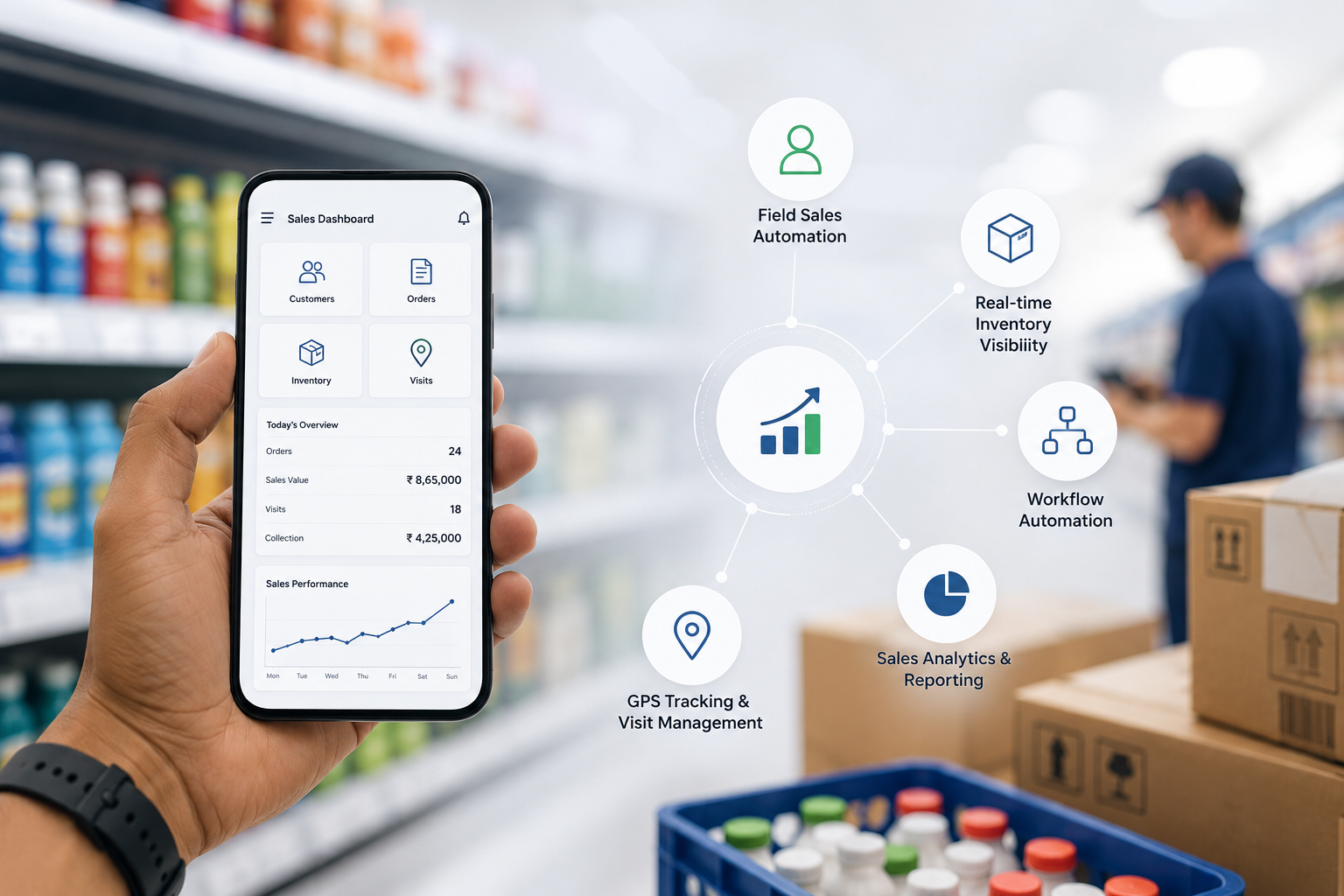
Zoho CRM, Zoho Inventory, Mobile Sales Application, GPS Tracking, Workflow Automation, Sales Analytics
Business Objective
The client sought to digitize and automate its end-to-end sales operations while improving field sales productivity, inventory visibility, order management, and sales performance.
Key objectives included:
- Digitize and automate the end-to-end sales process.
- Improve field sales productivity.
- Provide real-time inventory visibility to sales teams.
- Streamline order management and processing.
- Automate approval workflows and credit controls.
- Improve sales performance monitoring.
- Enable actionable reporting and analytics for data-driven decision-making.
Scope of services
BXI Technology implemented an integrated sales automation ecosystem covering:
- Zoho CRM implementation with a multilingual mobile sales application.
- Automated sales order processing.
- CRM integration with inventory and finance systems.
- GPS-based attendance and customer visit tracking.
- Approval workflow and credit control configuration.
- Sales dashboards and reporting.
- User training and adoption support.
- Post-go-live support and maintenance.
Benefits
- Increased visibility into field sales operations.
- Accelerated sales order processing.
- Improved inventory availability and visibility for sales teams.
- Reduced manual approval effort.
- Strengthened credit governance and controls.
- Enhanced sales performance monitoring.
- Enabled data-driven decision-making through real-time reporting and analytics.
Impact
BXI Technology delivered a unified sales automation platform connecting field sales, inventory, and finance within a single digital ecosystem. The solution streamlined sales operations, improved customer responsiveness, enhanced operational transparency, and established a scalable CRM foundation to support business growth across multiple regions.

Customer
A leading FMCG and hospitality group operating across the Middle East and Africa, with multiple business entities requiring a standardized and scalable HR management environment.
Technology
Zoho People Plus Enterprise, Zoho Recruit, Zoho Payroll, Zoho Learn, Zoho Connect, Microsoft 365, Biometric Integration, Oracle/Finance System Integration
Business Objective
The client sought to standardize HR operations across multiple countries and business entities while creating a unified digital platform for workforce management.
Key objectives included:
- Standardize HR operations across multiple countries.
- Digitize the end-to-end employee lifecycle.
- Automate payroll and attendance processes.
- Streamline recruitment and employee onboarding.
- Centralize employee records and HR information.
- Establish a unified HR platform with country-specific compliance.
- Improve visibility through HR analytics and reporting.
Scope of services
BXI Technology procured and implemented Zoho People Plus Enterprise across multiple entities, covering:
- Configuration of core HR and employee management.
- Recruitment and onboarding through Zoho Recruit.
- Payroll and attendance automation.
- Performance management and learning management.
- Employee self-service enablement.
- HR analytics and reporting.
- Integration with biometric devices.
- Microsoft 365 integration.
- Oracle/Finance system integration.
- Employee data migration.
- User training and UAT management.
- Long-term support and maintenance.
Benefits
- Centralized HR management across multiple countries.
- Standardized HR processes and governance.
- Automated employee lifecycle workflows.
- Improved payroll accuracy and compliance.
- Enhanced employee self-service.
- Real-time HR analytics and reporting.
- Simplified multi-country HR administration.
- Scalable support for future expansion.
Impact
BXI Technology delivered a unified cloud-based HR ecosystem that modernized workforce management across multiple countries and business entities. The solution improved operational efficiency, strengthened compliance, enhanced employee experience, and established a scalable digital HR foundation to support continued business growth and global operations.

Introduction
Modern energy ecosystems require intelligent orchestration of multiple energy sources, storage systems, and grid interactions. Traditional systems lack the flexibility to manage decentralized and hybrid energy environments. This case study highlights how a Digital Twin–driven energy management platform enabled real-time control, optimization, and scalability for a complex urban microgrid.
Customer
A Middle East–based renewable energy and infrastructure organization managing distributed energy assets.
Business Objective
- Enable real-time control of decentralized energy assets
- Optimize energy usage and storage across microgrid
- Improve grid resilience and independence
- Build scalable energy management architecture
Scope of Services
- Development of centralized energy management platform
- Integration of solar, battery storage, and grid systems
- Real-time monitoring and control of energy assets
- Dashboard and analytics implementation
- Multi-site energy optimization enablement
Technology Used
- Digital Twin–enabled energy management system
- SCADA + EMS platforms
- Real-time data ingestion and analytics
- IoT sensors and distributed energy integration
- Cloud-enabled scalable architecture
Key Challenges Addressed
- Managing decentralized and multi-source energy systems
- Integrating diverse hardware and protocols
- Ensuring real-time control and optimization
- Handling urban infrastructure constraints
Benefits
- Unified control across energy assets
- Improved energy optimization and efficiency
- Scalable and flexible architecture
- Enhanced operational visibility
Impact
- Real-time control of hybrid energy systems
- Ability to operate independently from main grid for limited duration
- Improved energy utilization and grid stability

Introduction
Energy optimization has become a critical priority for manufacturing organizations facing rising fuel costs and increasing environmental regulations. Inefficient fuel usage and lack of visibility into energy consumption often lead to higher operational expenses and regulatory penalties. This case study highlights how an energy-intensive manufacturing organization improved efficiency and sustainability by implementing telematics and energy monitoring solutions. By gaining real-time visibility into fuel consumption and optimizing equipment utilization, the organization reduced costs, improved environmental compliance, and enhanced overall operational performance.
Customer
An energy-intensive manufacturing organization facing rising fuel costs and environmental penalties across its operations.
Business Objective
- Reduce fuel consumption across operations
- Improve overall energy efficiency
- Minimize environmental impact and penalties
- Enhance visibility into energy usage patterns
- Support sustainability and cost optimization goals
Scope of Services
- Implementation of energy usage monitoring systems
- Integration of telematics for fuel and equipment tracking
- Deployment of energy optimization dashboards
- Analysis of fuel consumption and utilization patterns
- Continuous optimization of energy and operational efficiency
Benefits
- Improved visibility into fuel consumption and usage
- Better control over energy utilization across operations
- Reduced waste and inefficiencies in fuel usage
- Enhanced sustainability and environmental performance
- Improved decision-making through real-time insights
Impact
- Lower fuel expenses across operations
- Reduced environmental penalties
- Improved overall profitability

Introduction
AI-powered customer engagement enables airlines to deliver seamless booking experiences, reduce service workload, and improve customer satisfaction. A major Middle Eastern airline operating across 95 destinations faced increasing demand for faster, more intuitive customer interactions. Traditional customer service channels struggled to handle booking queries efficiently, leading to delays and inconsistent experiences. By implementing AI-powered customer engagement, the airline transformed how customers interact across booking and support journeys, enabling scalable and responsive digital experiences.
Customer
A major Middle Eastern airline operating across 95 destinations with rapid global expansion.
Business Objective
- Automate ticket booking and customer query handling
- Improve customer experience and engagement
- Reduce dependency on manual support channels
- Enable scalable digital interaction models
- Enhance accessibility through conversational interfaces
Scope of Services
- Implementation of AI-driven conversational interfaces for booking and support
- Automation of customer query handling across channels
- Integration with airline booking and customer systems
- Enablement of voice and chat-based interaction channels
- Optimization of customer interaction workflows
Benefits
- Faster and more intuitive booking experience
- Reduced customer service workload
- Improved accessibility via voice and chat
- Consistent customer interaction across channels
- Scalable engagement model supporting growth
Impact
- Improved customer satisfaction and engagement
- Increased efficiency in handling booking and service queries
- Reduced operational load on customer service teams
- Enhanced digital customer experience across journeys

Introduction
An AI recruitment automation platform enables organizations to streamline hiring processes, reduce manual effort, and improve candidate experience. An enterprise organization in the Professional Services industry faced inefficiencies in recruitment due to manual screening, inconsistent shortlisting, and slow communication with candidates. These challenges impacted hiring speed and recruiter productivity. By implementing an AI recruitment automation platform, the organization automated key hiring workflows, improved decision accuracy, and built a scalable recruitment model.
Customer
An enterprise organization in the Professional Services industry seeking to modernize recruitment and improve hiring efficiency.
Business Objective
- Automate candidate screening and shortlisting
- Improve speed and accuracy of hiring decisions
- Streamline interview scheduling and communication
- Reduce manual workload for recruiters
- Accelerate overall hiring cycles
Scope of Services
- Design and development of a virtual HR recruiter
- Automation of screening, shortlisting, and scheduling workflows
- Machine learning–based CV matching and evaluation
- API integration with job descriptions and candidate repositories
- Event-driven workflow automation for recruitment processes
Benefits of AI Recruitment Automation Platform
- Improved recruiter productivity and efficiency
- Faster and more accurate hiring decisions
- Simplified and seamless candidate experience
- Reduced operational costs and hiring cycle time
- Scalable recruitment operations
Impact
- Accelerated hiring cycles
- Improved quality of candidate selection
- Reduced recruiter workload
- Enhanced candidate experience

Introduction
IoT analytics is transforming how energy-intensive organizations monitor and optimize consumption. An organization operating IoT systems in the energy sector faced challenges in leveraging large volumes of sensor data effectively. Without a unified IoT analytics approach, energy usage insights remained fragmented and underutilized. By implementing an IoT analytics solution, the organization enabled real-time visibility, improved decision-making, and built a scalable foundation for energy optimization across operations.
Customer
An organization operating IoT systems in the energy sector, focused on improving energy efficiency through advanced analytics.
Business Objective
- Capture and process high-volume IoT sensor data
- Build an IoT analytics solution for energy monitoring
- Enable data-driven energy optimization
- Support scalable IoT data ingestion and analytics
- Establish a future-ready energy analytics foundation
Scope of Services – IoT Analytics Implementation
- Integration of sensor data into a centralized IoT analytics platform
- Design and deployment of IoT analytics solution on CGP
- Real-time and batch processing of sensor data
- Analytics enablement to identify energy usage patterns
- Optimization of data pipelines for scalability and reliability
Benefits of IoT Analytics
- Improved visibility into energy consumption patterns
- Identification of energy optimization opportunities
- Better utilization of IoT sensor data
- Scalable platform for growing IoT workloads
- Strong foundation for smart energy initiatives
Impact
- Reduced energy usage using IoT analytics insights
- Improved operational efficiency in energy monitoring
- Enhanced scalability of IoT-based energy solutions

Introduction
Airline Cargo Analytics Data Lake Implementation enables aviation organizations to unify operational and financial data for better business visibility and decision-making. Airlines often manage cargo operations and financial reporting across multiple systems, which creates fragmented data environments and delays insights. As cargo operations grow in complexity, airlines require scalable data platforms capable of integrating operational data with financial performance metrics.
This case study highlights how a Gulf-based airline modernized its data landscape by implementing a cloud-based data lake on AWS. By consolidating cargo operations and financial data into a unified analytics platform, the airline improved visibility into cargo performance, accelerated financial reporting, and established a scalable foundation for future analytics initiatives.
Customer
The customer is a Gulf-based airline managing a large cargo business alongside its passenger operations. Cargo performance plays a significant role in overall airline revenue and operational planning.
However, fragmented systems made it difficult to track cargo operations efficiently and generate timely financial insights. As a result, the airline needed a unified data platform capable of consolidating operational and financial data while supporting analytics-driven decision-making.
Business Objective
The primary objective was to establish a scalable cloud-based data lake that could consolidate cargo and financial data.
The airline also aimed to improve monitoring and tracking of cargo business operations while enabling accurate and timely financial reporting. Additionally, leadership wanted a unified data platform capable of supporting both operational analytics and financial insights.
Another key goal was to create a stable data environment that could support ongoing analytics initiatives and future data-driven decision-making.
Scope of Services
The engagement focused on building and supporting a cloud-based data lake, including:
-
Design and implementation of a Cloudera-based data lake on AWS
-
Ingestion and integration of cargo operations data
-
Integration of financial data for reporting and analysis
-
Enablement of analytics and reporting capabilities
-
Ongoing platform support and maintenance
Benefits
-
Improved visibility into cargo operations and performance
-
Faster and more reliable financial reporting
-
Unified data platform supporting both operational and financial analytics
-
Scalable cloud foundation for future analytics initiatives
-
Reduced dependency on fragmented legacy data systems
Impact
-
Better monitoring and control of cargo business performance
-
Improved decision-making across operations and finance
-
Increased agility in responding to market and business demands

Customer
This GCC IP monetization case study showcases how a Global Capability Center (GCC) enabled a global software and technology enterprise to convert acquired intellectual property into revenue-generating digital assets. The customer is a multinational software organization that established its Global Capability Center to centralize product engineering, innovation, and IP monetization initiatives.
The initiative demonstrates how a GCC can evolve beyond a cost-focused delivery model into a strategic innovation and commercialization hub. By modernizing legacy products, embedding AI capabilities, and accelerating go-to-market execution, the organization successfully transformed its IP portfolio into scalable commercial offerings while driving measurable business outcomes.
Business Objective
The primary objective of this GCC-led IP monetization program was to reduce dependency on legacy products and unlock new, scalable digital revenue streams.
Key objectives included:
-
Diversifying the organization’s revenue profile
-
Monetizing existing software assets and acquired intellectual property
-
Modernizing products with AI-enabled capabilities
-
Expanding service offerings and commercial engagement models
-
Improving global product roadmap alignment and market responsiveness
This transformation repositioned the Global Capability Center as a growth enabler rather than a traditional support function.
Scope of Services
BXI Technology partnered closely with the customer’s Global Capability Center to deliver an end-to-end IP monetization and product transformation program. The scope of services included:
-
Assessment and rationalization of acquired IP and legacy software assets
-
Product modernization focused on scalability, performance, and innovation
-
Establishment of innovation centers to accelerate roadmap execution
-
Creation of a dedicated customer success capability to improve renewals, cross-sell, and up-sell performance
-
Product engineering investments to infuse AI and advanced analytics into core platforms
-
Commercial enablement to support new engagement models and indirect sales channels
-
Global delivery support across multiple geographies with optimized sourcing timelines
The program emphasized rapid execution while maintaining product stability, market relevance, and long-term value realization.
Benefits
-
Diversified revenue streams through structured IP monetization
-
Improved customer retention and renewal outcomes
-
Faster product innovation cycles enabled by modern engineering practices
-
Reduced operational inefficiencies from legacy product structures
-
Enhanced commercial reach through partner-led and indirect channels
-
Stronger alignment between product strategy, engineering, and go-to-market execution
Impact
-
7 solution areas successfully commercialized
-
6-month sourcing and integration timeline achieved
-
14+ global customers onboarded
-
Major product releases delivered within 12 months of IP acquisition
-
Software labs established across 2 continents and 14 locations

ABOUT THE CLIENT
A leading international developer and operator of premium hotels & resorts
BUSINESS OBJECTIVES
The customer aimed to enhance guest experience, improve online conversions, and modernize digital touchpoints across all properties. They required a connected, data-driven hospitality platform that integrates customer journeys across booking, stay, loyalty, and service touchpoints.
SCOPE OF SERVICES
End-to-end IT services for hospitality operations
Development of a unified Connected Customer Experience Platform
Integration of booking engines, loyalty systems, and CRM
Multi-property digital experience standardization
BENEFITS
- Strengthened brand visibility and recognition globally
- Higher customer loyalty due to consistent digital service experience
- Operational efficiency through integrated digital systems
IMPACT
- 63% increase in online resort bookings
- 27% increase in cross-property customer engagement
- Standardized digital experience across all international properties