

Technology Brilliance

Introduction

In the gaming industry, early success is often driven by a single breakout title. However, sustaining growth requires transitioning from a product-centric organization to a scalable, multi-product entertainment business.

A fast-growing gaming company faced this exact inflection point—strong commercial success from a flagship game, but an organizational structure that could not support expansion, innovation, or cross-product scalability.

Customer

A rapidly growing video game company with a successful flagship title, struggling to scale into a multi-product entertainment business due to structural and operational limitations.

Business Objective

  • Transition from single-product success to a multi-product portfolio
  • Enable scalable game development and publishing capabilities
  • Improve collaboration across teams and business units
  • Establish a structure that supports long-term growth and innovation

Scope of Services

Enterprise Operating Model Redesign

Defined a new organizational structure aligned to product portfolios and enterprise functions, enabling scalability and clarity.

Product-Centric Organization Design

Reorganized teams around multiple product lines instead of a single flagship offering, enabling parallel development and innovation.

Role & Accountability Realignment

Redefined responsibilities across a large portion of the workforce to ensure clear ownership and reduce execution friction.

Governance & Execution Framework

Established a centralized transformation office to manage execution, track progress, and drive adoption across teams.

Collaboration & Integration Model

Created mechanisms to improve coordination between product, publishing, and enterprise functions.

Technology Used

  • Organizational Design Frameworks
  • Workforce Planning & Role Mapping Tools
  • Performance Tracking Dashboards
  • Collaboration & Workflow Platforms

Key Challenges Addressed

  • Overdependence on a single successful product
  • Organizational structure not designed for scale
  • Lack of clarity in roles and responsibilities
  • Limited cross-team collaboration
  • Inability to efficiently launch multiple products

Benefits

Scalable Product Development

Enabled parallel development of multiple gaming experiences

Improved Organizational Clarity

Clear accountability reduced execution delays and confusion

Stronger Collaboration

Aligned teams across product, publishing, and enterprise functions

Faster Innovation Cycles

Improved ability to launch new products and experiences

Impact

  • 50%+ increase in B2B commercial revenue within the first year
  • Increased volume and frequency of product launches
  • Improved ability to deliver cross-product player experiences
  • Strengthened foundation for long-term growth

Introduction

Traditional industrial monitoring systems are designed for static environments, but modern logistics and energy operations demand real-time visibility across highly dynamic and distributed assets. This case study demonstrates how a mobile energy provider implemented a scalable IIoT-driven platform to monitor, control, and optimize operations across a constantly moving fleet, enabling resilience, uptime, and real-time decision-making.

Customer

A North America–based mobile energy and logistics provider operating a large fleet of distributed assets.

Business Objective

  • Enable real-time monitoring across mobile and remote assets
  • Ensure high system uptime and resilience
  • Improve visibility across distributed operations
  • Support scalability with growing fleet size

Scope of Services

  • Implementation of distributed SCADA and IIoT platform
  • Real-time fleet monitoring and control
  • Connectivity optimization across networks (cellular, WiFi, satellite)
  • Centralized visibility dashboards for operations and management

Technology Used

  • IIoT-enabled SCADA platform
  • Real-time data streaming and telemetry
  • Multi-network connectivity (cellular, WiFi, satellite)
  • Edge computing for remote assets
  • Centralized monitoring dashboards

Key Challenges Addressed

  • Monitoring assets that are constantly moving across regions
  • Connectivity variability across geographies
  • Lack of centralized visibility across distributed operations
  • Need for high uptime and resilience

Benefits

  • Real-time visibility across mobile operations
  • Improved uptime and operational reliability
  • Better decision-making through centralized insights
  • Scalable architecture supporting growth

Impact

  • Real-time monitoring across hundreds of remote sites
  • Improved operational control across dynamic fleet environments
  • High uptime achieved through resilient architecture

Introduction

Following a large-scale merger, a global media organization faced increasing pressure to improve cash flow visibility and financial efficiency. While revenues remained stable, poor working capital management limited liquidity and reduced the organization’s ability to reinvest and respond to market dynamics.

The challenge was not growth; it was unlocking trapped cash within existing operations.

Customer

A multinational media enterprise undergoing post-merger integration, dealing with fragmented financial processes and inconsistent cash management practices across business units.

Business Objective

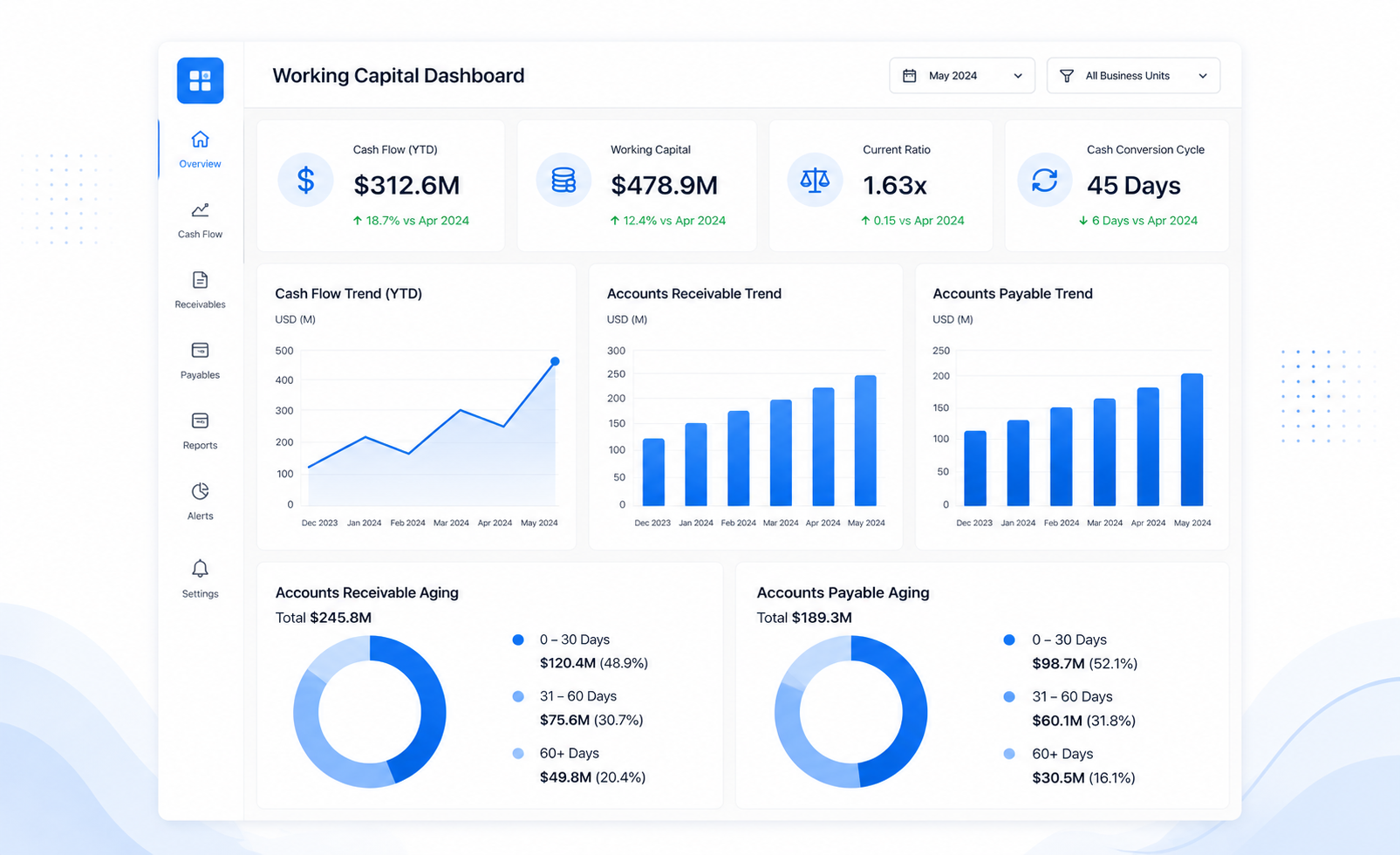
  • Improve cash conversion cycle and free cash flow visibility
  • Identify and unlock working capital trapped in operations
  • Standardize financial processes across merged entities
  • Strengthen control over receivables and payables

Scope of Services

Working Capital Diagnostic

Conducted a structured assessment of accounts receivable and payable processes, identifying inefficiencies across the cash cycle.

Process Deep-Dive (Order-to-Cash & Procure-to-Pay)

Analyzed end-to-end financial workflows to uncover delays in collections and inefficiencies in vendor payment structures.

Opportunity Identification & Prioritization

Identified multiple high-impact levers to improve liquidity, including customer payment delays and suboptimal vendor terms.

Financial Visibility Framework

Designed a centralized tracking and reporting mechanism to monitor working capital performance across business units.

Transformation Roadmap & Governance

Established a structured execution plan supported by a program management office (PMO) to drive adoption and ensure accountability.

Key Challenges Addressed

  • Lack of visibility into real-time cash flow performance
  • Delayed customer payments impacting liquidity
  • Vendor payment terms below industry benchmarks
  • Fragmented financial processes post-merger
  • Absence of standardized working capital governance

Benefits

Improved Cash Visibility

Enabled leadership to track free cash flow and working capital performance in real time

Optimized Financial Processes

Standardized receivables and payables management across business units

Stronger Vendor & Customer Management

Improved control over payment cycles and contractual terms

Structured Financial Governance

Introduced accountability through centralized monitoring and execution frameworks

Impact

  • Identified opportunities to unlock $800M+ in cash benefits within two months
  • Improved cash conversion cycle across business units
  • Reduced delays in receivables and optimized payables structure
  • Strengthened financial control in a post-merger environment

Introduction

Product portfolio transformation is critical for global software companies managing multiple acquired products and fragmented offerings. Disconnected product lines often lead to inconsistent customer experiences, slower innovation cycles, and missed revenue opportunities. This case study highlights how a global software product company restructured its portfolio, modernized products with cloud-native and AI capabilities, and established a scalable innovation model. By aligning product strategy with customer needs and market opportunities, the organization improved monetization, accelerated releases, and strengthened its competitive positioning.

Customer

A global software product company with multiple acquired products, operating across diverse geographies and customer segments.

Business Objective

  • Consolidate and rationalize fragmented product portfolio
  • Monetize existing IP and software assets
  • Accelerate product innovation and time-to-market
  • Improve customer retention and engagement
  • Enable scalable product engineering and delivery

Scope of Services

  • IP acquisition and portfolio restructuring
  • Product modernization using cloud-native architectures
  • Infusion of AI/ML capabilities into product offerings
  • Product roadmap definition and execution
  • Customer success and lifecycle enablement
  • Channel and partner ecosystem enablement
  • API and integration framework standardization

Benefits

  • Increased monetization of existing product assets
  • Expanded solution portfolio and revenue streams
  • Improved customer retention and renewal rates
  • Faster innovation cycles and release velocity
  • Scalable product engineering and delivery model

Impact

  • Clear and scalable product roadmap established
  • Improved customer engagement and retention
  • Faster time-to-market for new product releases
  • Stronger cross-sell and up-sell capabilities
  • Sustainable innovation and engineering foundation

Introduction

Digital experience transformation is redefining how public transportation authorities engage with citizens and travelers. Modern mobility ecosystems require seamless, intuitive, and accessible experiences across airports, transit hubs, and digital platforms. Traditional infrastructure-focused approaches often fail to meet evolving expectations of convenience, personalization, and inclusivity. This case study highlights how a regional transportation authority transformed its ecosystem by integrating human-centered design, immersive technologies, and digital innovation. By leveraging AR/VR, mobile platforms, and multi-cloud infrastructure, the organization created future-ready transportation experiences while optimizing costs and accelerating innovation.

Customer

A leading Australian regional transportation authority responsible for managing metropolitan transport infrastructure, including airports, train stations, and multimodal transit systems.

Business Objective

  • Design future-ready transportation assets aligned with long-term mobility vision
  • Deliver accessible and world-class traveler experiences
  • Position transport infrastructure as experience-driven destinations
  • Reduce total cost of ownership through outsourcing and cloud adoption
  • Accelerate innovation through incubation and digital experimentation

Scope of Services

  • Human-centered design for airport and transit experiences
  • Development of citizen-facing mobile applications
  • AR/VR-based experience prototyping and visualization
  • Strategic outsourcing of applications and infrastructure
  • Multi-cloud enablement and migration
  • Innovation incubation through rapid prototyping and validation

Benefits

  • Improved citizen and traveler engagement
  • Enhanced accessibility and inclusivity across services
  • Reduced long-term IT and operational costs
  • Faster innovation cycles through incubation approach
  • Scalable and flexible digital infrastructure

Impact

  • Delivery of immersive AR/VR-based experience designs
  • Enablement of next-generation traveler experiences
  • Foundation for scalable and future-ready transport systems
  • Strengthened positioning of transport infrastructure as destinations

Introduction

AI-driven customs clearance optimization enables logistics companies to reduce delays, improve compliance accuracy, and enhance international shipment efficiency. Customs processing is often a major bottleneck due to manual documentation, regulatory complexity, and risk assessment challenges. This case study highlights how a global courier and express logistics company transformed customs clearance into a competitive advantage by leveraging AI, image recognition, and analytics. By automating classification, predicting risks, and enabling real-time workflows, the organization significantly improved clearance speed and accuracy.

Customer

A US-based global courier and express logistics company handling large volumes of international shipments and customs operations.

Business Objective

  • Transform customs clearance into a competitive differentiator
  • Predict shipment caging risks proactively
  • Reduce manual documentation errors
  • Improve accuracy and speed of clearance processes
  • Enhance international shipment efficiency

Scope of Services

  • HS code prediction using AI/ML models
  • Risk scoring models for shipment evaluation
  • Document and image processing automation
  • Real-time workflow enablement for customs operations
  • Integration with logistics and compliance systems

Benefits

  • Reduced customs delays and processing time
  • Improved accuracy in classification and documentation
  • Lower risk of compliance errors and penalties
  • Faster clearance workflows
  • Enhanced operational efficiency in international logistics

Impact

  • 94–97% success rate in caging identification
  • Reduced revenue leakage from classification errors
  • Faster international shipment processing
  • Improved compliance and clearance accuracy

Introduction

Digital commerce platforms enable logistics providers to unify customer interactions, improve shipment visibility, and deliver seamless end-to-end experiences. Fragmented systems across channels often lead to inconsistent customer journeys, limited visibility, and increased dependency on support teams. This case study highlights how an APAC-based logistics provider transformed its operations by building a unified digital commerce platform. By integrating cloud infrastructure, DevOps pipelines, and real-time tracking capabilities, the organization enhanced customer experience, improved operational visibility, and reduced service overhead.

Customer

An APAC-based integrated logistics service provider operating across multiple business units and customer channels.

Business Objective

  • Eliminate fragmented customer experience across channels
  • Create a unified digital commerce platform
  • Improve end-to-end shipment visibility
  • Reduce dependency on support channels
  • Enable scalable digital operations

Scope of Services

  • Development of a unified digital business platform
  • Cloud infrastructure setup and automation on AWS
  • Implementation of track-and-trace MVP
  • Integration across business units and systems
  • Deployment of recovery and resilience mechanisms

Benefits

  • Unified and consistent customer experience
  • Improved visibility across shipment lifecycle
  • Reduced dependency on call-center support
  • Enhanced operational efficiency
  • Scalable digital platform for growth

Impact

  • 20% reduction in customer churn
  • 28% reduction in call-center volumes
  • Single unified view of customer transactions
  • Improved customer engagement and retention

Introduction

Connected fleet platforms enable logistics providers to leverage real-time telematics data for operational efficiency, predictive maintenance, and new revenue streams. Traditional fleet operations often lack integrated visibility across vehicles, leading to reactive maintenance, inaccurate ETAs, and limited ability to monetize data. This case study highlights how a leading trucking and logistics provider transformed its fleet operations by implementing a connected telematics platform. By integrating IoT data, predictive analytics, and route optimization, the organization improved operational predictability, enhanced customer experience, and unlocked new monetization opportunities.

Customer

A leading US-based trucking and logistics provider operating a fleet of approximately 0.5 million vehicles across large-scale transportation networks.

Business Objective

  • Monetize telematics and fleet data
  • Enable predictive maintenance across vehicles
  • Improve ETA accuracy and customer experience
  • Enhance operational visibility and efficiency
  • Prepare for electric and autonomous vehicle integration

Scope of Services

  • Design of connected fleet platform architecture
  • Real-time ingestion of telematics and vehicle data
  • Predictive maintenance analytics implementation
  • Route optimization and ETA prediction logic
  • Development of data monetization frameworks
  • Integration with OEMs and service providers

Benefits

  • Reduced maintenance costs through predictive insights
  • Improved compliance through digital inspection (eDVIR)
  • Better operational predictability across fleet operations
  • Enhanced visibility into vehicle performance
  • Scalable platform for future mobility innovations

Impact

  • Improved customer satisfaction through accurate ETAs
  • Enabled value-added services through data monetization
  • Proactive maintenance reducing downtime risks
  • Enhanced efficiency in large-scale fleet operations

Introduction

AI-driven customer service optimization enables logistics organizations to reduce support costs, improve customer experience, and uncover hidden operational inefficiencies. Logistics providers handling large volumes of shipments often rely heavily on call-based customer support, leading to rising costs and inconsistent service quality. Limited visibility into the root causes of customer queries further restricts optimization efforts. This case study highlights how a logistics major leveraged analytics and AI to transform customer service operations, identify inefficiencies, and establish a scalable foundation for AI adoption across shipping workflows.

Customer

A logistics organization operating large-scale shipping and customer service operations with high dependency on call-based support and service desk interactions.

Business Objective

  • Reduce customer service support costs
  • Improve customer satisfaction and experience
  • Identify hidden inefficiencies in operations
  • Enable data-driven decision-making
  • Scale AI adoption across logistics processes

Scope of Services

  • Analysis of customer service call data and shipping operations
  • Correlation of customer interactions with operational events
  • Identification of inefficiencies and bottlenecks
  • Root cause analysis of customer dissatisfaction drivers
  • Identification and prioritization of AI use cases
  • Continuous analytics and insight delivery
  • Experimentation and validation of AI-driven solutions

Benefits

  • Reduced dependency on live customer service agents
  • Improved understanding of cost and inefficiency drivers
  • Faster identification of operational bottlenecks
  • Data-driven prioritization of automation initiatives
  • Continuous improvement through analytics insights

Impact

  • 13% reduction in customer calls through IVR and conversational AI
  • 30+ analytical reports delivered to stakeholders
  • 5+ AI use cases and POCs successfully implemented
  • Improved visibility across customer service and shipping operations
  • Established foundation for scalable AI adoption

Introduction

AI-powered customer engagement enables airlines to deliver seamless booking experiences, reduce service workload, and improve customer satisfaction. A major Middle Eastern airline operating across 95 destinations faced increasing demand for faster, more intuitive customer interactions. Traditional customer service channels struggled to handle booking queries efficiently, leading to delays and inconsistent experiences. By implementing AI-powered customer engagement, the airline transformed how customers interact across booking and support journeys, enabling scalable and responsive digital experiences.

Customer

A major Middle Eastern airline operating across 95 destinations with rapid global expansion.

Business Objective

  • Automate ticket booking and customer query handling
  • Improve customer experience and engagement
  • Reduce dependency on manual support channels
  • Enable scalable digital interaction models
  • Enhance accessibility through conversational interfaces

Scope of Services

  • Implementation of AI-driven conversational interfaces for booking and support
  • Automation of customer query handling across channels
  • Integration with airline booking and customer systems
  • Enablement of voice and chat-based interaction channels
  • Optimization of customer interaction workflows

Benefits

  • Faster and more intuitive booking experience
  • Reduced customer service workload
  • Improved accessibility via voice and chat
  • Consistent customer interaction across channels
  • Scalable engagement model supporting growth

Impact

  • Improved customer satisfaction and engagement
  • Increased efficiency in handling booking and service queries
  • Reduced operational load on customer service teams
  • Enhanced digital customer experience across journeys